

From Newbie to Belonging
How Choirhub Welcomes New Members
Chris Mills
2/15/20263 min read
Joining a choir can be surprisingly vulnerable.
You walk into a room full of strangers.
You don’t know the routines, the music, or the unwritten rules.
You’re trying to find your part, your place, and your confidence — all at once.
For many people, that first few weeks in a choir can make or break their experience. Some feel immediately included. Others quietly drift away, not because they don’t love singing, but because they feel lost, overwhelmed, or disconnected.
When I built Choirhub, I kept thinking about that moment — the moment a new singer decides whether this choir feels like “home.” Technology might seem like an odd place to start when talking about belonging. But in reality, the way a choir organises itself — and communicates — has a huge impact on how welcome people feel.
If a new member can’t find the music, doesn’t know the rehearsal schedule, or misses key messages, they start to feel out of step before they’ve even begun. That’s why Choirhub was designed not just as a management tool, but as a bridge into community.
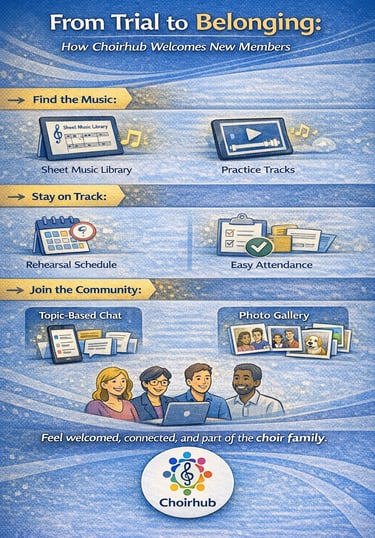
From day one, a new member can see:
exactly where the sheet music lives,
their own rehearsal tracks,
the choir calendar, and
the latest messages from the director or committee.
There’s no guessing, no chasing emails, no awkward “I didn’t know” moments. Instead of feeling like an outsider trying to catch up, new singers are brought inside the circle straight away.
Belonging is built in conversation — not just in rehearsal
One of the things that makes Choirhub different from other choir apps is that we treat communication as social, not just administrative.
Our Chat system isn’t just a messaging tool — it’s a place where choir life happens between rehearsals.
Rather than one chaotic message stream, Choirhub uses topic-based chats, so conversations stay clear and easy to find. For example:
rehearsal updates,
concert planning,
social events,
music questions,
general chit-chat,
or anything else your choir wants to talk about.
This means important information doesn’t get buried — but it also means people can actually connect with each other in a natural, friendly way. For new members, this is incredibly powerful.
They can:
see how the choir talks to each other,
join conversations at their own pace, and
start to feel like part of the group long before they know everyone’s name.
The Gallery: where memories live
Beyond chat, Choirhub also includes a Gallery, which plays a quiet but significant role in building belonging.
Here, members can upload photos from:
rehearsals,
concerts,
workshops,
social events,
or even just everyday choir life — and yes, sometimes their dog too. 🐶
Over time, this becomes a shared visual story of your choir. New members don’t just read about the choir — they see it. They see people laughing together, performing together, and celebrating together.
That kind of shared memory helps transform “a group I sing with” into “my choir.”
From newbie to belonging
New members can explore the choir’s music, follow conversations, and even browse the Gallery as they learn their way around. They don’t need to navigate complicated systems or remember multiple passwords — everything is in one place.
Over time, this changes the tone of how people join in.Instead of feeling like they’re outsiders they experience themselves as being invited into a community.And that shift matters.Belonging isn’t just about singing well together. It’s about feeling seen, included, and connected.
When information is clear, people relax.
When people relax, they sing better.
When they sing better, the choir grows stronger.
Choirhub doesn’t create belonging on its own — people do that.But it removes unnecessary barriers, and adds social spaces, so belonging has room to grow.In that sense, Choirhub is less about technology and more about hospitality.It’s about making sure that every new voice feels welcomed, valued, and able to participate fully — musically and socially — from the very beginning.
Because a choir isn’t just a group of singers — it’s a living community.
And when that community has the right tools, it can thrive.