

From Paper Scores to Digital Scores (Without the Drama)
Saving the planet, one sheet of paper at a time
Chris Mills
2/13/20262 min read
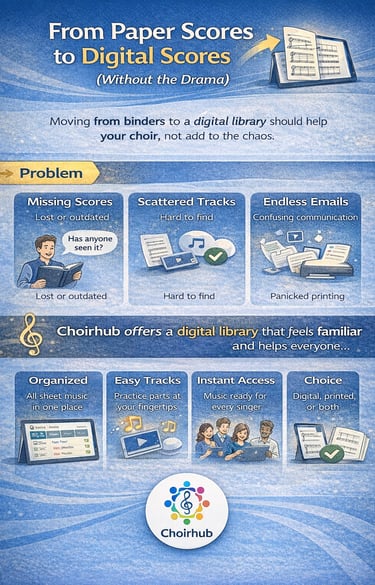
For most choirs, sheet music has always been something you can touch, flip through, and scribble on.
Dog-eared pages.
Pencil marks everywhere.
And, inevitably, someone asking, “Has anyone seen my copy of page 17?”
When I began building Choirhub, I wasn’t trying to abolish paper. I wasn’t trying to “make choirs digital” for the sake of it. What I wanted was something far more practical: to make music easier to access, easier to share, and easier to keep organised — without losing the musical heart of choir life.
The problem with traditional paper systems is not that they are bad. It’s that they are fragile. They take up storage space which has to be paid for. Then there is the copying and the sheer volume of paper that isn't in the least bit environmentally friendly
Scores get lost.
Parts get mixed up.
New members arrive without copies.
Directors send updates and half the choir misses them.
And rehearsal tracks end up scattered across emails, USB sticks, and forgotten cloud folders.
Over time, this creates friction — not just for administrators, but for singers too.When I first started experimenting with digital scores, I saw both excitement and hesitation from choir members.Some loved the idea immediately. Others worried it would be complicated, impersonal, or just another thing to learn.
That’s when I realised something important: moving from paper to digital only works if it feels natural.That’s why Choirhub’s digital music library was designed to feel familiar, not futuristic.
Instead of treating sheet music like files in a database, Choirhub presents it like a real choir library:
clearly labelled pieces,
organised folders,
and instant access for every member.
If you know how to browse music in a physical folder, you already know how to use it.
Rehearsal tracks were the same story. In many choirs, practice tracks live everywhere and nowhere at the same time. One person has them on Dropbox, another on Google Drive, and half the choir can’t find them when they need them. With Choirhub, every singer knows exactly where to go. Their part is right there alongside the score — no hunting, no confusion, no missing links.
For directors and librarians, this shift is equally powerful.
Instead of spending hours emailing files, uploading updates, or chasing missing parts, they can focus on what really matters: music, rehearsal, and community. And for singers, digital scores don’t replace musicianship — they enhance it. You can zoom in on tricky passages, mark up PDFs on a tablet, or listen to your part while following along visually. Suddenly, practice becomes more flexible and more personal.
But here’s the key: Choirhub doesn’t force anyone to abandon paper.
If a choir still wants to print scores, they can. If individual singers prefer paper, that’s fine too. Digital is there to support, not dictate. What Choirhub does is simply remove the drama.
No more missing music.
No more lost files.
No more frantic emails before rehearsal.
Just one clear, shared, digital home for your choir’s music.
Because at the end of the day, whether it’s paper or pixels, what really matters is the same thing: people coming together to sing.
Technology should make that easier — not harder.