

If My Mum Can Use It, It's Good Enough
Community Choirs need singers, not tech experts.
Chris Mills
2/12/20262 min read
When I first started imagining Choirhub, I had one very simple test in my head:
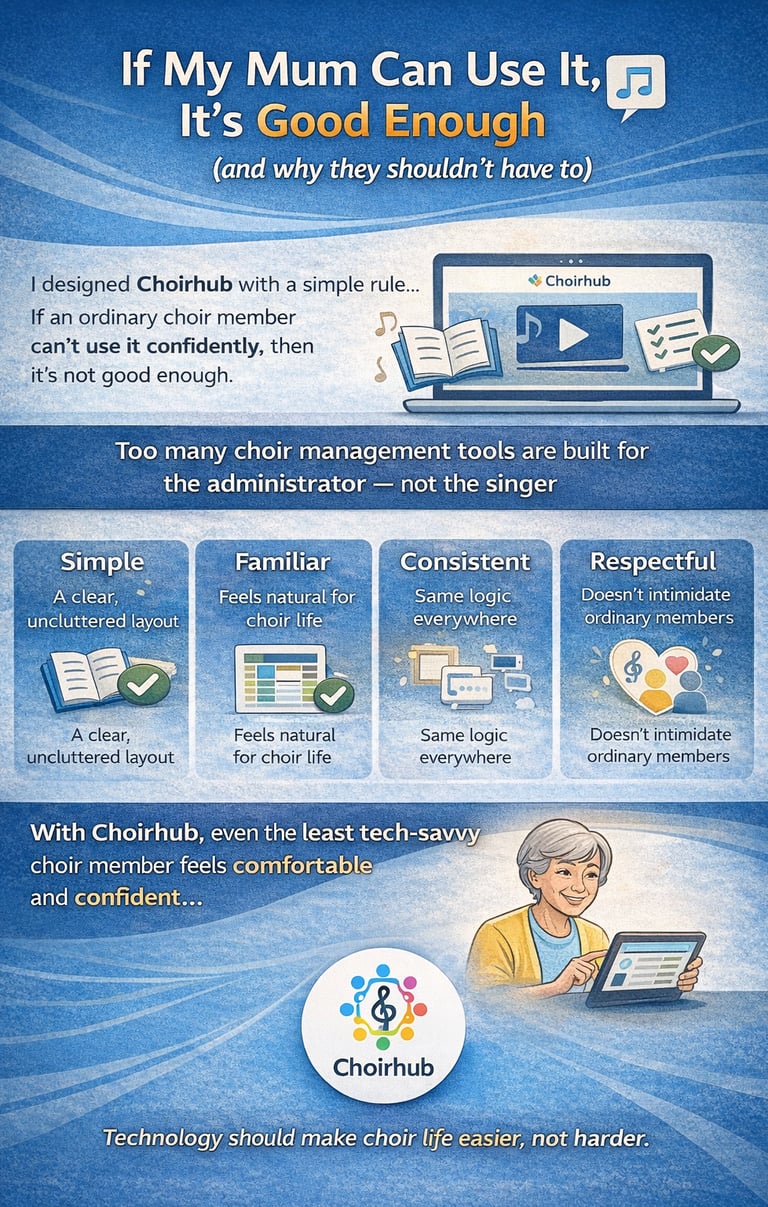
If an ordinary choir member couldn’t use it confidently, then it wasn’t good enough.
That might sound blunt — but it became my most reliable design principle.
I’ve spent enough years around community choirs to know something important:
choir members are wonderfully diverse. Some are tech-savvy, some are cautious, and many just want to sing without having to “learn an app.”
That reality shaped every decision I made.
In the early days, I watched how people actually behaved. I noticed who got lost in shared folders, who missed emails, who struggled to download rehearsal tracks, and who quietly gave up trying to use whatever system the choir had adopted.
It wasn’t that these people were “bad with technology.”
It was that the technology wasn’t designed for them.
Most choir tools are built from the perspective of the administrator — the director, the librarian, or the committee. They optimise for data, control, and structure.
Choirhub was built from the opposite direction.
I designed it first for the singer in the back row who just wants to:
find their sheet music,
listen to their rehearsal track,
know when rehearsal is,
and feel connected to their choir.
If that person could navigate Choirhub without stress, then I knew I was on the right track.
That’s why simplicity became such a central value.
I deliberately avoided cluttered screens, confusing menus, and jargon-heavy labels. Instead, I focused on clear pathways, familiar icons, and language that felt natural to choir life rather than corporate life.
For example:
Music lives in a library, not a database.
Rehearsal tracks are easy to play, not buried in obscure folders.
Messages are organised in clear channels, not lost in endless email threads.
Attendance is quick and visual, not hidden in spreadsheets.
Another key idea was consistency.
If something works in one part of Choirhub, it should feel similar everywhere else. That way, once members learn one part of the system, they don’t have to start from scratch in another.
Over time, this approach has paid off.
Choirs who adopt Choirhub often tell me that their members pick it up surprisingly quickly — even those who were initially nervous about using new technology.
That’s exactly what I hoped would happen.
Because for me, usability isn’t just a technical feature — it’s an act of respect. If we want people to engage fully in their choir, we have to remove unnecessary barriers, not add more.
Choirhub isn’t trying to impress anyone with clever engineering. It’s trying to make life easier for real people who care deeply about music and community.
So yes — if my mum can use it, then I know we’ve done something right.
And that principle will continue to guide Choirhub as it grows.